
Fine Motor Advice and Strategies

What are Fine Motor Skills?
Fine motor skills are the ability to make controlled and precise movements using the small muscles in our hands and wrists and involve the coordinated efforts of the brain, nervous system and muscles. Whilst these movements come so naturally to most people that we usually don’t think about them, the development of this skill begins to build from the day we are born and carries on developing throughout our lifetime.
Why are fine motor skills important?
Children use fine motor skills to complete all of their play, self-care, social and school related tasks. They support children performing tasks such as feeding themselves, grasping toys, buttoning and zipping clothes, writing, drawing, and more. The ability to complete self-care, educational and other everyday tasks helps a child’s self-esteem and confidence to increase as well as encourage independence.
Developing fine motor skills in early childhood is vital, as it builds the foundation for important future skills; for example we cannot expect children to be able to write if they haven’t yet developed the strength needed in their hands and fingers to grasp a pen correctly and we cannot expect a child to be able to dress themselves if they cannot manipulate buttons or zips. Therefore, fine motor skills should be encouraged in our children through opportunities of play that are fun and interactive for your child.
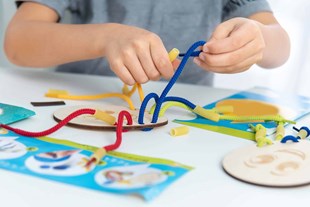

What can I do to support my child's fine motor skills?
All children are different and develop certain skills at a different pace. Fine motor skills are no different and whilst some children develop hand strength and fine motor skills early on, others may need a little more support, practice and experience to do so. Just like with teaching a child to roll, crawl, walk or talk, Children need adult support to develop fine motor skills. To support you with this ongoing skill development, we have put together some great resources which are free for you to access and offer lots of toy, play and activity ideas for all ages from birth through to 4 years old.
- Fine Motor Development Ideas for Babies (0-12 months)
- Fine Motor Development Ideas for Toddlers (1-3 years)
- Fine Motor Development Ideas for Pre-Schoolers (3 years +)
To access these resources, please see the documents section at the bottom of this page.
Fine motor skills for children with developmental conditions
Some underlying medical conditions can have an enormous impact on our children's fine motor skill development as the intrinsic muscles in the hands as well as the larger muscles in the wrists, forearms and shoulders may develop differently. As well as this, some conditions result in what are commonly referred to as hand and upper limb deformity's, which can effect grasp and functional activity. For these children, we advise that a referral is made to the Children's Early Years Occupational Therapy team so that we can undertake an assessment and offer more bespoke advice as required. For more information on how to refer to the service, please click here.
Alongside this, we have also put together some useful advice handouts that are designed to support children with commonly seen conditions which can effect fine motor development.
- Theraputty programme- A great resources that offers lots of simple and fun activities to undertake with your child using a therapy like putty called Theraputty which is purchasable online. This programme is ideal for those children with weak grasps and muscles of the hand such as Downs Syndrome and hypermobility.
- Hemiplegic Activity Ideas- Activity ideas to support those children with Hemiplegic Cerebral Palsy. These activities are designed for children from the ages of 18 months plus.
To access these resources, please see the documents section below.
-
Children's EY's OT- Fine Motor Skill Documents
