
Visual perception & visual motor integration information and resources

What is visual perception?
Visual perception is the way we know and understand the world around us through what we see. It is not just our ability to see things, but our ability to make sense of what we see. Therefore, children who have difficulty with visual perception often find the world a very confusing place.
Visual perception includes:
- Visual discrimination
- Visual memory
- Spatial Relationships
- Form constancy
- Sequential memory
- Visual figure-ground
- Visual closure
What is visual motor integration (VMI)?
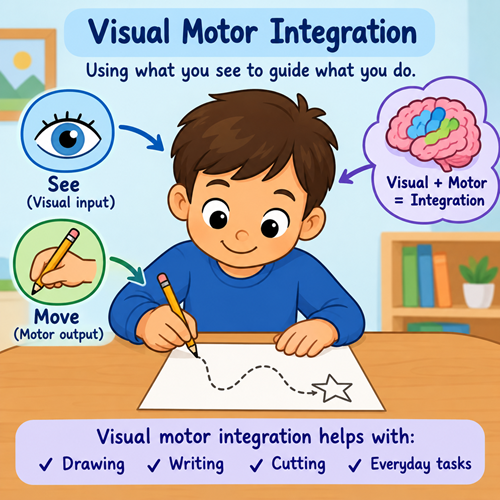
‘Visual motor integration (VMI) is the degree to which visual perception and finger-hand movements are well coordinated’ (Beery, 2004). Children translate what they see into a motor movement. Those with weak visual motor integration know what they want to do, but are unable to complete the task satisfactorily as they have difficulty producing the accuracy of movement.
Visual motor integration is an essential component for the development and refinement of all practical skills including handwriting and drawing. Efficient visual motor integration is needed to catch a ball, thread a needle, colour within boundaries, use visual guidelines for cutting or write on lines. It is important that visual motor integration is developed adequately and is therefore automatic, so that attention can be focused on the content, not the execution of the task.
How will you test my child’s visual perception and visual motor integration (VMI) skills?
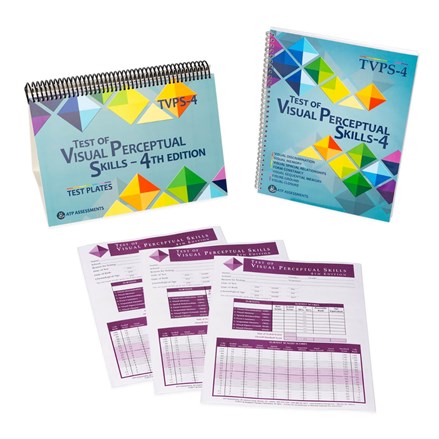
Child will be seen by the Occupational Therapy Assistant at Cherry Tree House, Clatterbridge Hospital. During this 1-hour appointment the Test of Visual Perception (TVPS-4) and Visual Motor Integration (Beery VMI-6) assessments are administered – results interpreted and analysed by the Occupational Therapist prior to motor skills test appointment.
TVPS-4 test
This is an untimed, motor free assessment measuring visual-perceptual strengths and weaknesses. The evaluation consists of seven subtests that use black and white line drawings in a multiple-choice format, minimising motor and verbal response requirements. The subtests are as follows:
- Visual discrimination
- Visual Memory
- Spatial relationships
- Form constancy
- Sequential memory
- Visual Figure-ground
- Visual closure
Beery VMI - 6 test
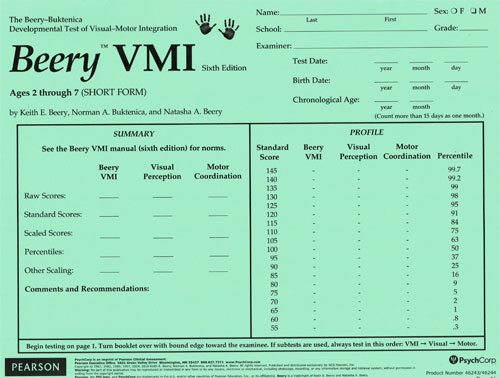
This is a pen and paper assessment that requires the child/ young person to copy shapes/ forms of increasing difficulty. The reason for screening VMI are that these skills form some of the foundations for handwriting development - it is a good indicator if a child is at pre-writing level still.
For further information on Visual Motor Integration (VMI) and visual perception including what are the implications and strategies to develop skills see information sheets at bottom of page.
